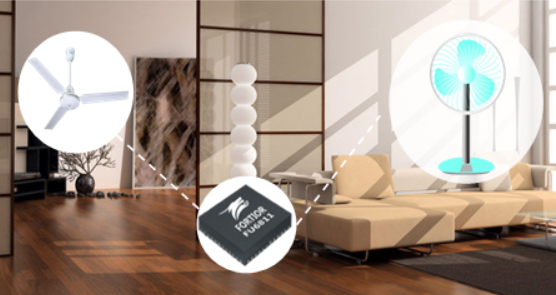
The high-performance motor drive chip incorporates ME core and 8051 core. ME core integrates FOC, MDU, LPF, PI, and SVPWM/SPWM modules that allow for automatic calculation of FOC or square-wave control by the hardware for sensored/sensorless BLDC motors. 8051 core is used for parameter configuration and routine processing. Most of 8051 core instruction cycle takes 1T or 2T clock cycle(s). The dual cores work in parallel to achieve high-performance motor control. The chip integrates high-speed operational amplifiers, comparators, Pre-drivers, high-speed ADC, multipliers/dividers, CRC, SPI, I2C, UART, LIN, and multi-Timers, PWM modules and built-in high-voltage LDO, which are suitable for square-wave based BLDC/PMSM motors, SVPWM/SPWM, and FOC drive control.
Enabling highly efficient FOC motor drive with minimal peripheral circuitry. The sensored startup and sensorless operation FOC drive of FU6832 is mainly applied in low-voltage fans, with typical applications including standing fans, air cleaners and so on. This application mainly introduces the features and application methods of FU6832 MCU solution and the control features and functions of example programs.
FU6832 features:
Dual-core: 8051 core and ME core;
An instruction cycle mostly takes 1T or 2T clock cycle(s);
16kB Flash ROM with CRC,self-program and code protection;
256 bytes IRAM, 768 bytes XRAM;
ME:Proportional-Integral-Derivative (PI/PID) controllers, BLDC module, FOC module, MDU supporting multiplication/division, low-pass filter (LPF), and trigonometric function calculations;
1T 16x16 multiplier, 16T 32/16 divider;
15 interrupt sources with 4 configurable priority levels;
Number of GPIOs:
FU6832L: 35;
Timers:
2*Programmable timers with capture feature;
1*QEP decoding programmable timer;
1*BLDC motor dedicated timer;
1*General-purpose timer;
1*RTC;
1*SPI;
1*I2C;
2*UARTs, wherein UART2 supporting LIN Slave mode and Pin function switching;
Dual-channel DMA: supporting data transmission via I2C/SPI/UART
Analog Peripherals:
12-bit ADC, operating with 1μs conversion time and internal VREF or external VREF selectable as reference voltage
Number of ADC channels:
FU6832L: 14;
Internal VREF. 3V, 4V, 4.5V or VDD5 can be selected as the internal reference.
Internal VHALF, with 1/2 VREF reference output
3 standalone operational amplifiers, where the gain of AMP0 is configurable
3-channel analog comparator
DAC: 1-channel 9-bit, 1-channel 6-bit
Driver Type:
3P3N Predriver output;
Automatic commutation, cycle-by-cycle current limiting and Hall/BEMF-based position sensing for BLDC motor control;
FOC module supports single/dual/triple-shunt current sampling;
FOC module supports overmodulation;
System clock
Built-in 24MHz ± 2% precision clock;
Built-in 32.8kHz low-speed clock;
Watch-dog;
Two-wire FICE protocol based in-circuit emulation;
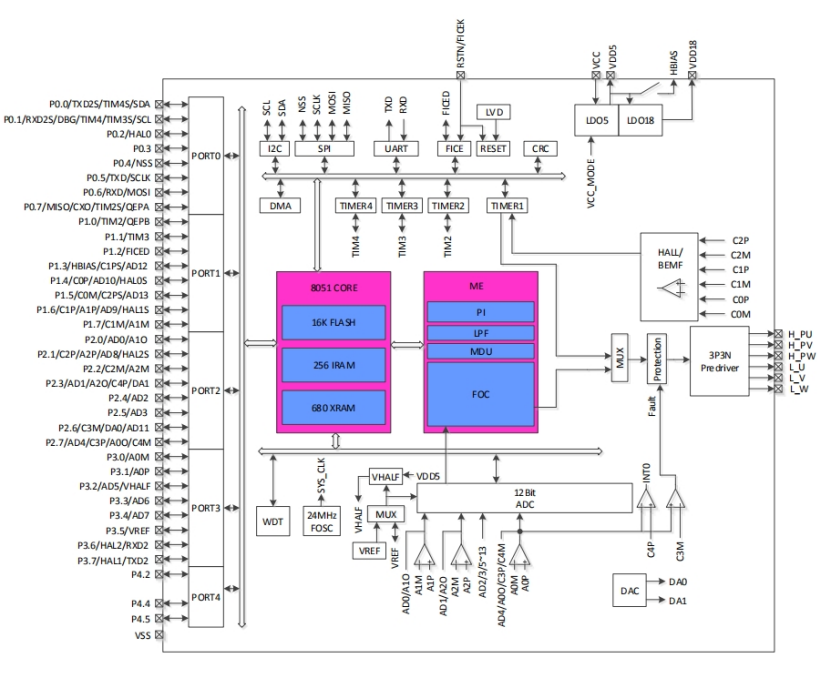
Figure 1 FU6832L Functional Block Diagram
Application features:
FOC solidification and fast operation: Sensorless control method is applied, where all computations for sensorless FOC are hardware-implemented. The solution saves software runtime. With a maximum PWM frequency of 50 kHz, it can be applied to ultra-high-speed motors;
High control accuracy and efficiency: Q15 fixed-point format is applied, the electrical angle 360° expanded to 2^15, the angular resolution reaching 0.01° can realize high accuracy control to the motor; the upgraded position estimation algorithm can realize high efficiency control;
Low noise: The FOC algorithm enables precise control of the drive current as a smooth sine wave,resulting in minimal torque ripple. Dead-time compensation can be incorporated to achieve ultra-quiet operation;
Smooth and fast startup: Sensored startup method is applied. Sensorless operation is switched to when the speed reaches 5% ~10% of the highest and the estimated angle is in a certain range to insure the startup reliability and stability; Startup time is 50% shorter than that of normal startup mode;
Low speed: When the motor operates at a very low speed, its running current and BEMF are minimal, leading to significant control errors if sensorless operation is used. For the sensored startup and sensorless operation solution, if a lower speed is required (for example, a 5-pole-pair motor needs to run at 50 RPM), it can switch to sensored operation;
Simple hardware circuit:Minimal peripheral circuitry that internal integrated high-speed operational amplifier, high-voltage LDO and Pre-Drive are connected to MOS directly to drive the motor, so that it can lower the product cost and improve the reliability of the system.
Sensored startup and sensorless FOC Applications:
To facilitate customer development, Fortior Technology has developed a sample program for sensored startup and sensorless operation FOC drive based on FU6832, which features the following characteristics:
1. Startup Control
(1) By detecting the initial state of the motor through Hall sensors, the system employs sensored FOC control until the speed reaches 5% to 10% of the maximum speed and the estimated angle is in a certain range. This enables dynamic startup (including both tailwind and headwind detection protection), thereby enhancing startup reliability
(2) To reduce startup noise, the sensored startup also adopts a sinusoidal drive method. The angle increment between two Hall states is calculated based on the speed from the previous cycle
(3) Debug startup torque and time according to the fact
(4) The startup employs a current closed-loop control method, enabling wide-voltage startup and allowing the setting of a maximum startup current.
2. Control Mode
(1) The current closed-loop serves as the inner loop, while various control options such as constant airflow control, constant torque control, constant speed control, and constant power control can be selected as the outer loop.
(2) Speed regulation interface: SREF/PWM/Clock/IR/UART
3. State Display
LED indicates the system's operational status (Normal/Fault).
4. Protection Control
The system includes comprehensive internal protections, allowing you to enable the corresponding protections as needed and fine-tune them based on actual conditions.
(1) Over-voltage protection: The over-voltage protection is triggered when the voltage is higher than the over-voltage threshold and the system restarts when the voltage is lower than the restore threshold
(2) Under-voltage protection: The under-voltage protection is triggered when the voltage is lower than the under-voltage threshold and the system restarts when the voltage is higher than the restore threshold
(3) Over-current protection: The over-current protection is triggered when the current is higher than the over-current threshold
(4) FO protection: The hardware over-current protection is impulsed by large current and the system will not restart
(5) Motor lock protection: The system allows for the configuration of motor lock restart time and the number of motor lock restart attempts
(6) Phase-loss protection: In the event of poor motor wire contact, the system can implement phase-loss protection, with restart time and the number of attempts being configurable
(7) Over-temperature protection: The over-temperature protection is triggered when the temperature is higher than the over-temperature threshold and the system restarts when the temperature is lower than the temperature restore threshold
(8) Over-power protection: Over-power protection can be implemented as either input power protection or output power protection. When the power reaches the set protection threshold, the system can either reduce speed or shut down
(9) Operational amplifier bias voltage abnormal protection: After the control board is powered on and before the motor starts running, the system first checks whether the operational amplifier's output is within the normal range. If not, an error is reported, and the motor does not start.
5. User Interface
The system includes a variety of user interface options, allowing you to enable the corresponding interfaces as needed to meet control requirements.
(1) Key interface: Define key interface and provide Key command. You can define Key command, like ONOFF control command, FR control command, and speed up and down command.
(2) SREF interface: Provide potentiometer value for ADC sampling and give SREF commands. You can define SREF command, like closed-loop Speed reference value
(3) PWM interface: Capture PWM signal, gain PWMDuty, and give PWM command. You can define PWM command, like closed-loop Speed reference value
(4) Clock interface: Capture PWM signal, gain PWM frequency, and give PWM command. You can define PWM command, like closed-loop Speed reference value
(5) IR interface: Define infrared interface. Provide IR command after receiving infrared data, like ONOFF control command, FR control command, closed-loop Speed reference value
(6) UART interface: Provide UART command after receiving UART data. You can define UART command, like ONOFF control command, FR control command, closed-loop Speed reference value
(7) Buzzer interface: Define buzzer interface. Realize alarm or warning after receiving control command from Buzzer. You can define Buzzer command, like key warning control and gear tone control
6. Debugging Interface
Under the default functional settings, the program provides the Customer.h document as your debugging interface. You shall only modify the corresponding parameters to achieve general motor control functions.
Evaluation board FU6832 includes:
1. FU6832 DEMO board
2. FU68XX emulator
3. Sensored startup and sensorless FOC operation application debugging note
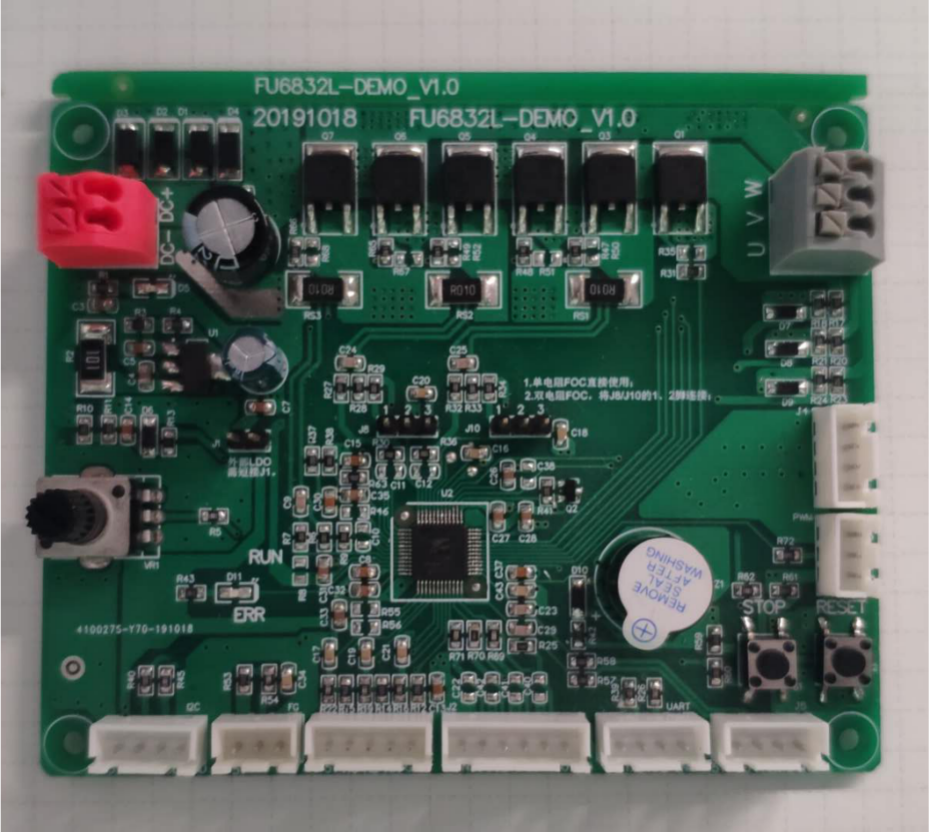
Figure 2 FU6832
Schematic Diagram:
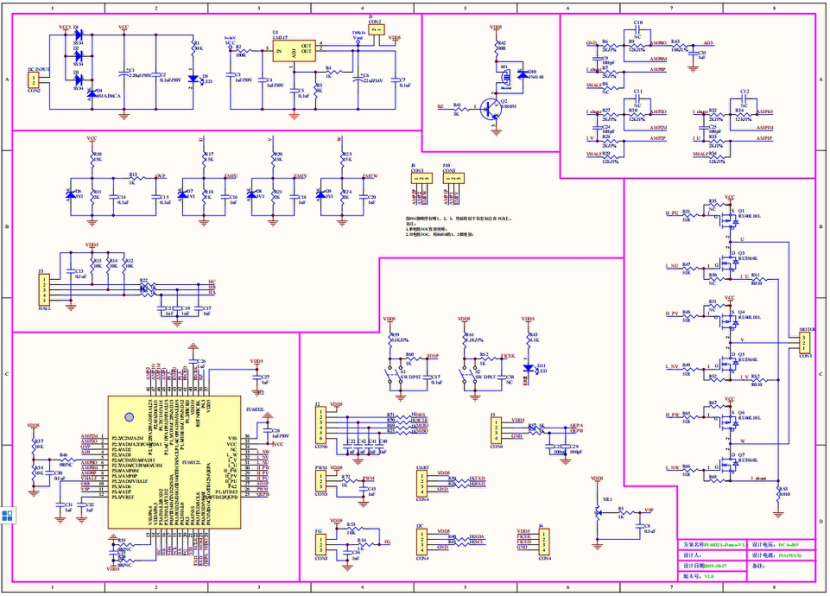
Figure 3 FU6832 Schematic Diagram
This website uses cookies and similar tracking technologies to enhance your experience, analyze site usage, and provide personalized advertising. You can choose which types of cookies to allow below. For more information on personal data processing, please review our Privacy & Protection Policy