


As vehicle intelligence and electrification evolve, in-vehicle auxiliary motor drive systems are undergoing a comprehensive upgrade — moving from traditional mechanical actuation toward high-precision, low-power, highly reliable, and integrated electronic control solutions. Core components such as fans, electric pumps, seats, doors/windows, and smart-cockpit actuators impose stringent automotive-grade requirements on the stability, adaptability, and safety of motor control chips.
As a leading player specializing in the motor drive and control sector in China, Fortior Technology (A stock code: 688279.SH; H stock code: 1304.HK) has launched four dedicated three-phase motor control MCUs — FU7512Q1, FU7564Q1, FU7565Q1, and FU7574Q1 — built on its fully self-developed motor-specific IP core and proprietary dual-core ME algorithm architecture. The series comprehensively covers a wide range of in-vehicle motor drive scenarios, using superb chip performance to help automotive electronic systems become lighter and smarter, and providing automakers and supply-chain customers with cost-effective, integrated, China-based drive solutions.
 1. Automotive-Grade Dual-Core Architecture Delivers Unmatched Reliability for Full-Domain Motor Control
All four chips of the Fortior FU75 series are certified to AEC-Q100 Grade 1 and operate reliably across an extreme wide temperature range, perfectly suited to the demanding conditions of automotive use — high/low temperature cycling, strong vibration, and vehicle-level electromagnetic interference — giving the entire series top-tier environmental resilience for automotive applications.
1) All-in-One Proprietary Architecture for Full-Domain Motor Control
The four chips of the FU75 series use Fortior's proprietary MCU architecture for motor control. Unlike traditional general-purpose MCUs that emulate motor control in software, this series has a full suite of natively hardware-implemented motor control resources, which are SoCs truly dedicated to motor drive.
Three chips of the FU75 series (FU7564Q1, FU7565Q1, FU7574Q1) require no external gate-driver IC, operational amplifier, power management chip, or protection circuitry — a single chip handles the entire workflow of motor sampling, algorithm computation, PWM output, fault protection, and vehicle-level communication, greatly simplifying the customer's peripheral circuit design.
The entire series is natively compatible with sensorless/sensored BLDC motors, permanent magnet synchronous motors (PMSMs), three-phase/single-phase induction motors, and servo motors — a single chip adapts to multiple categories of in-vehicle motors across the whole vehicle, thoroughly resolving the traditional pain points of excessive chip variants, cumbersome stocking, and poor compatibility.
2) Smooth, Energy-Efficient Operation with On-Board High-End FOC
At the algorithm level, the chips carry Fortior's advanced automotive FOC vector-control engine, refined over many years, featuring high-precision Park/Clarke transforms, dynamic deadtime compensation, intelligent switching between seven-segment/five-segment SVPWM, high-frequency-injection sensorless startup, multi-mode flux observers (CFO/NFO/AFO), and low-speed observers, among other core technologies.
This enables zero-jitter startup while the motor is stationary, stable high-torque operation at low speed, no efficiency loss during high-speed field weakening, and extremely fast response to dynamic loads — effectively solving industry-wide problems such as low-speed noise, speed drift, and load stutter in
in-vehicle motors, while significantly reducing overall vehicle operating noise and energy consumption, fully meeting the core ride-comfort needs of quiet, smooth, and energy-efficient NEVs.
3) Microsecond-Level Hardware Protection Built for Automotive Safety
Designed for the complex and demanding operating conditions of vehicles, the series offers automotive-grade reliability and all-around hardware protection, supporting an ultra-wide operating
temperature range of -40°C to 125°C and withstanding voltage fluctuations, transient high voltage, strong EMI, and alternating high/low-temperature shocks — delivering long-term operating stability far exceeding general-purpose MCU solutions.
The chips feature a full-chain, hardware-level, real-time protection mechanism: all protection functions are natively triggered in hardware without software intervention, with microsecond-level response. Coverage includes MOSFET VDS over-voltage protection, 6N pre-driver shoot-through interlock protection, system under-/over-voltage protection, thermal shutdown protection, and motor overcurrent, stall, phase loss, and abnormal load protection — enabling rapid output shutdown and fault-state latching under extreme conditions, preventing burnout, failure, or malfunction of in-vehicle actuators, and ensuring the safe and stable operation of the vehicle's electronic control system.
4) Low Power and High Integration for Lower Cost and Higher Efficiency in Mass Production
Peripheral resources are highly integrated, natively equipped with mainstream automotive communication and sampling resources, including CAN, LIN automotive-dedicated buses, I2C, SPI, and UART general-purpose communication interfaces, multiple high-precision 12-bit ADC sampling units, and dedicated motor timer/counters, supporting single-, dual-, and triple-shunt current-sampling modes. Customers can interface with the vehicle's electronic control system without additional peripheral expansion.
The chips also feature low-power sleep, fast wake-up, and dynamic power-adjustment characteristics, with extremely low standby power consumption, effectively reducing the vehicle's static power draw and improving overall driving range. This highly integrated, highly reliable, low-power, all-in-one design significantly lowers customers' hardware design difficulty, software development threshold, and BOM cost, while markedly shortening product R&D, debugging, and mass-production cycles — suited to automakers' large-scale production needs.
2. Four Differentiated Chips Deliver Complete Coverage of In-Vehicle Application Scenarios
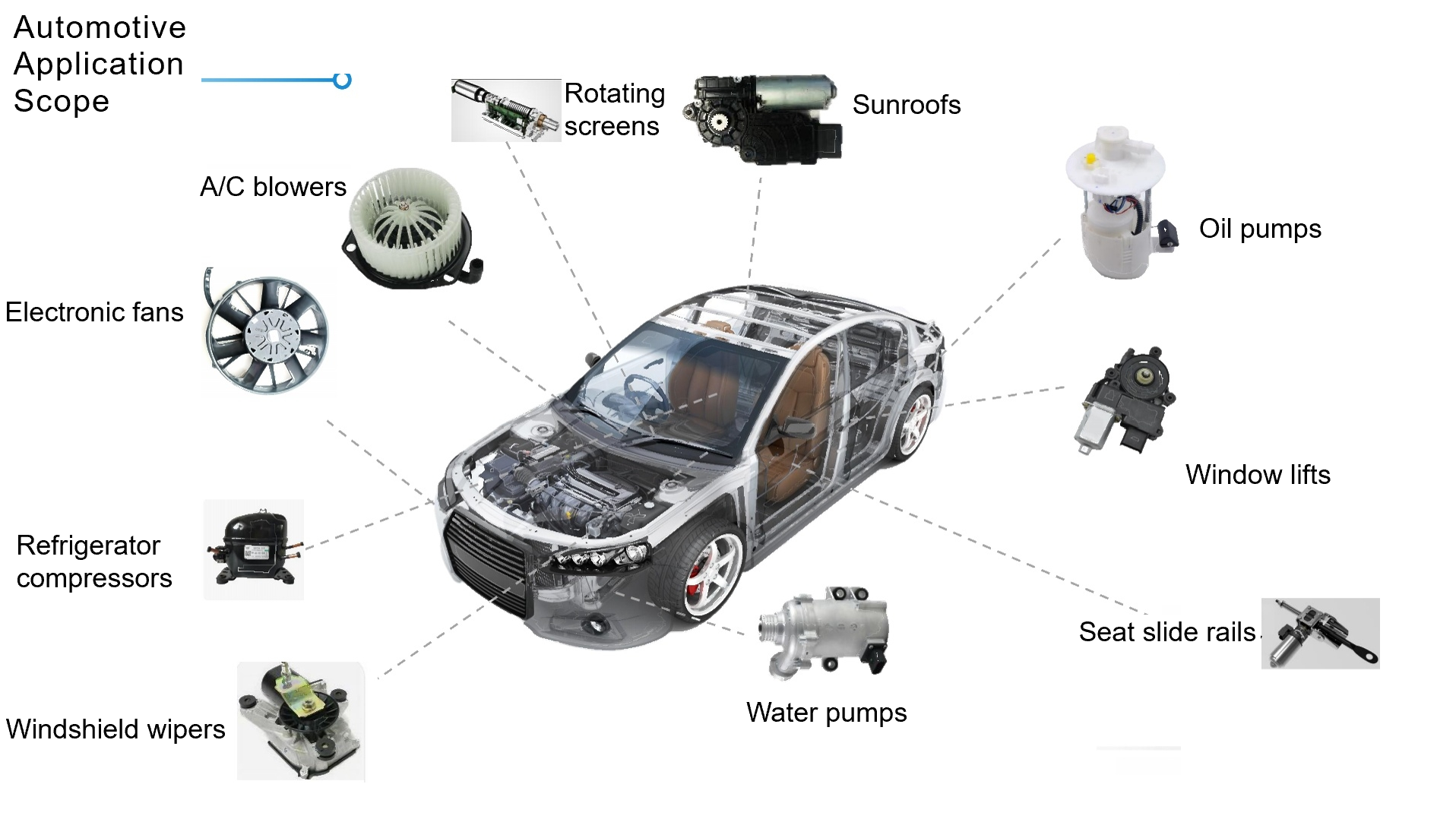
Fortior has precisely identified the needs of automotive-electronics sub-scenarios. Based on the power, precision, and integration requirements of different in-vehicle actuators, the four chips have been differentiated in function and package, precisely matching the mass-production needs of devices such as oil pumps, water pumps, blowers, and compressors, and comprehensively covering the four core domains of in-vehicle thermal management, body control, smart cockpit, and smart actuation mechanisms.
FU7512Q1 | Cost-Effectiveness · Preferred Choice for Thermal-Management Solution in Mass Production
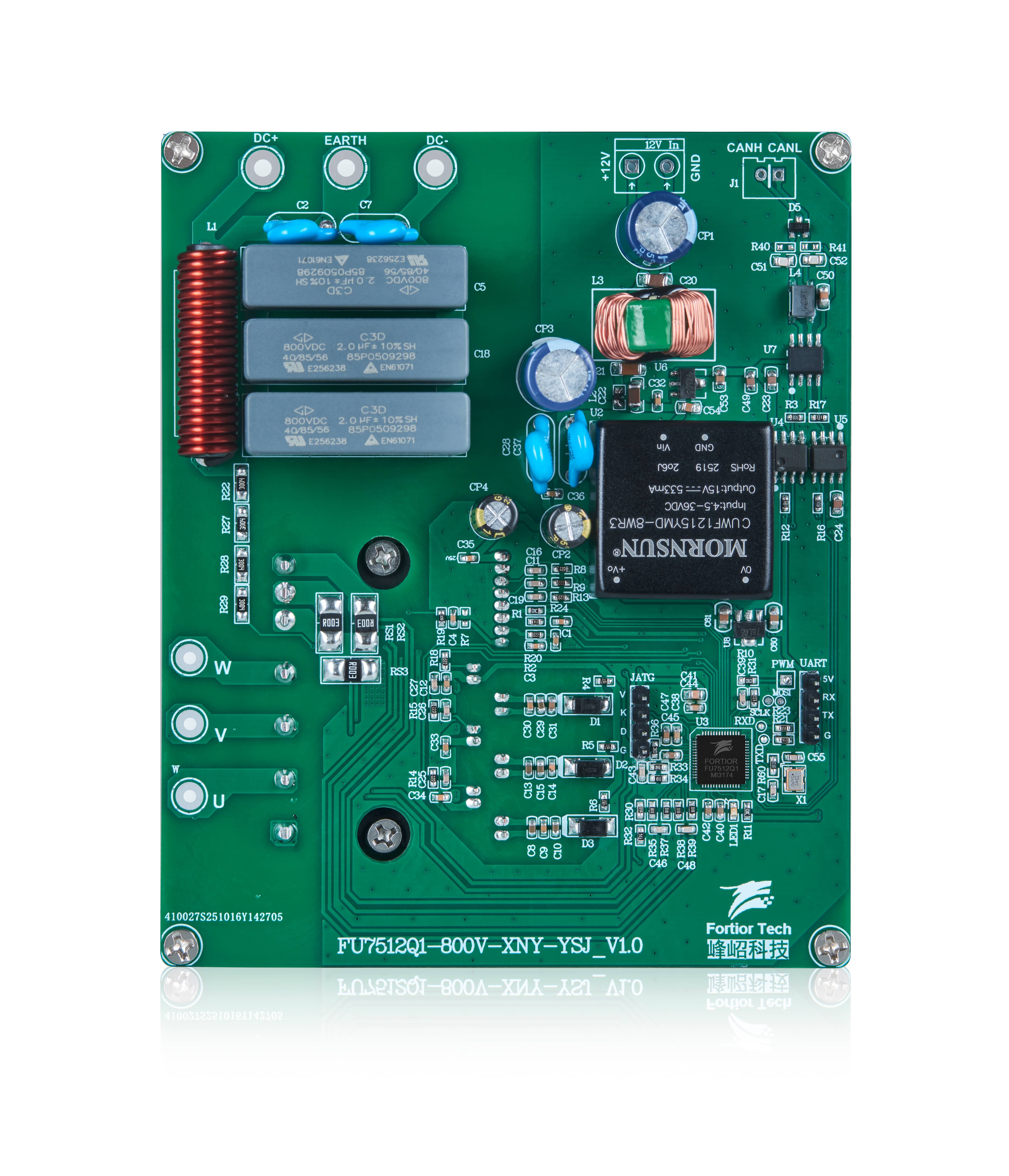
Fig. FU7512Q1 evaluation board
1) Core Positioning
A top-tier automotive-grade MCU with the fullest resource configuration and no built-in pre-driver, primarily targeting multi-axis servos, heat-pump compressors, and high-power thermal-management assemblies.
Aimed at high-precision, multi-sensor, high-power in-vehicle motor scenarios, it is optimized for external power-MOSFET solutions, with computing power and analog resources maxed out.
2) Core Hardware and Performance
Uses an external power-supply architecture with no integrated pre-driver module, and features dual independent PWM outputs supporting synchronous control of two three-phase motors. Peripheral configuration is industry top-tier, with dual SPI, dual I2C, a dedicated BiSS encoder interface, multiple programmable op-amps, and several independent high-precision sampling channels — the abundant analog channels can simultaneously acquire pressure, temperature, flow, and other in-vehicle sensor signals. It natively integrates an interleaved-PFC hardware module, perfectly suited to the high-power boost conditions of heat-pump compressors and effectively suppressing bus harmonic interference. The whole series complies with the AEC-Q100 Grade 1 standard and features a full suite of hardware fault protection and a hardware FOC architecture for stable, reliable operation.
3) Core Application Scenarios
Supports high-precision BiSS-encoder closed-loop position control, ensuring impact-free start/stop and precise positioning for sunroofs, rotating large displays, and multi-axis seat servo mechanisms. Features a heavy-load MTPA full-range efficiency algorithm suited to long-duration, continuous full-load operation of compressors, effectively reducing unit heat generation and running power consumption. Compatible with multiple shunt-sampling modes and paired with a carrier frequency-sweeping EMC optimization algorithm, it efficiently suppresses radiated interference under high-power conditions, helping end products easily pass stringent vehicle high-voltage EMC testing.
FU7564Q1 | High Integration · Smart Body-Control Drive Solution
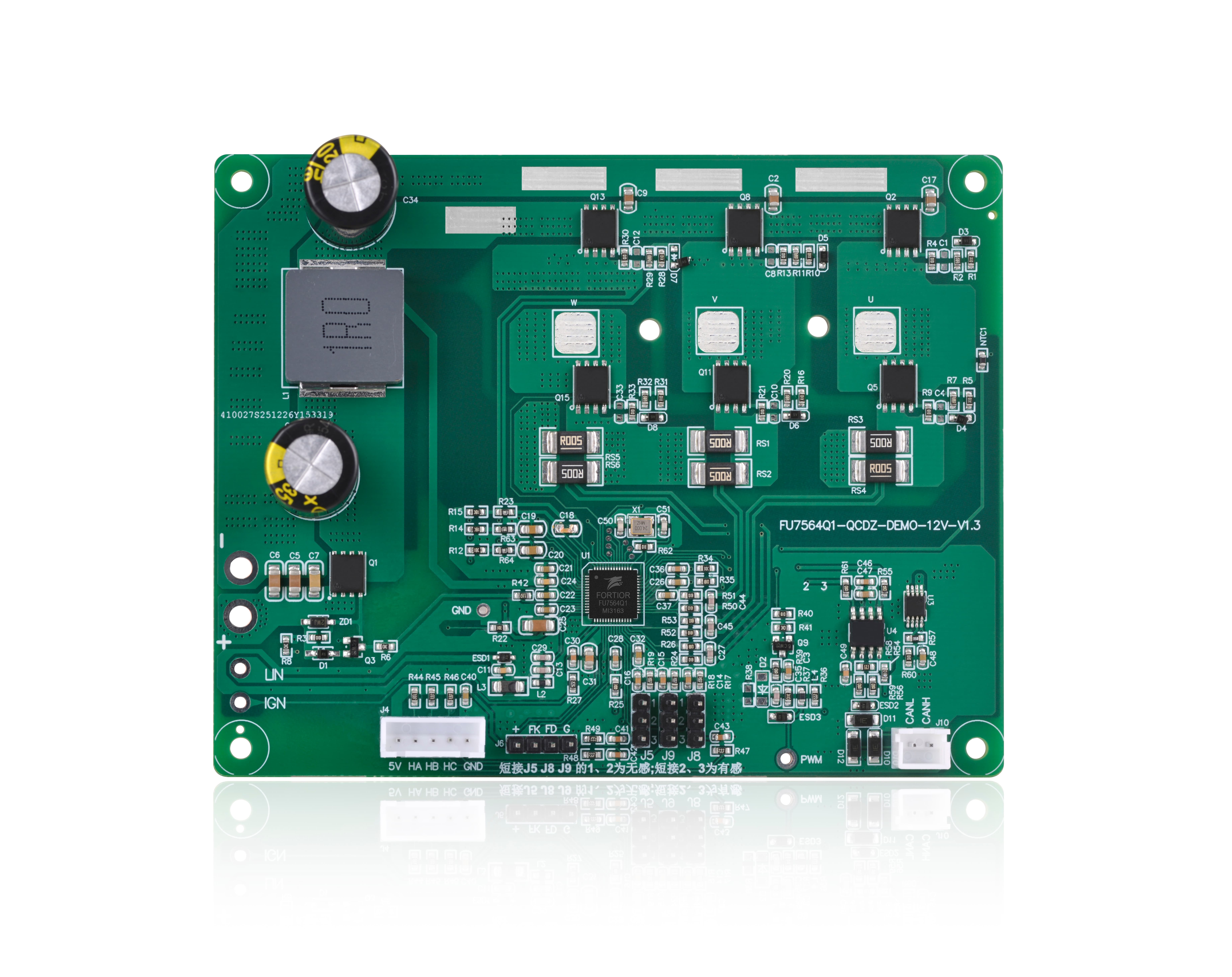
Fig. FU7564Q1 evaluation board
1) Core Positioning
A dedicated, fully integrated automotive-grade chip for mainstream low-voltage vehicle platforms, with a built-in single-channel pre-driver module. Purpose-built for oil pumps, cooling water pumps, and single blowers under high-load, low-temperature, frequent start/stop conditions, it is the core workhorse for low-cost mass production of in-vehicle sensorless-motor solutions.
2) Core Hardware and Performance
Suited to the vehicle's standard low-voltage power system, with on-chip integrated gate pre-driver, charge pump, and voltage-regulation unit — a single chip integrates both main-control and drive functions, keeping peripheral components extremely minimal. Built-in LIN transceiver and CAN/CAN FD dual-bus communication modules, paired with multiple high-precision ADC sampling channels, rely on a
hardware-based ultra-fast fault shutdown mechanism.
3) Core Application Scenarios
Comprehensively covers vehicle-wide low-voltage single-motor devices, including oil pumps, electronic water pumps, single blowers, wipers, power windows, active grille shutters, seat ventilation, and small in-vehicle air pumps — suited to the vast majority of standard low-voltage in-vehicle motor mass-production projects.
FU7565Q1 | Compact Size · Dedicated to Precision, Low-Power Cockpit Applications
 Fig. FU7565Q1 evaluation board
1) Core Positioning
A dedicated drive and control chip for NEV mild-hybrid platforms, with a built-in buck converter circuit, natively suited to the vehicle's 48V system power architecture, and offering excellent shock resilience under operating conditions plus top-tier EMC performance.
2) Core Hardware and Performance
Suited to the vehicle's power system, with an on-chip integrated high-performance buck converter circuit requiring no external power chip. Built-in pre-driver, on-chip voltage regulator, and LIN transceiver, in a compact package suited to the fine-grained layout of various small modules. It stably meets the highest automotive standard, AEC-Q1 Grade 1, across the full temperature range, handling voltage fluctuations, EMI, and other complex conditions under high-voltage operation.
3) Core Application Scenarios
Comprehensively covers the full range of NEV mild-hybrid in-vehicle equipment, including water pumps, blowers, electric fans, hybrid oil pumps, suspension air pumps, in-vehicle oxygen generators, and panoramic sunroof sunshade mechanisms, among other auxiliary motor applications.
FU7574Q1 | Flagship Model · High-End, Full-Domain Motor Control
 Fig. FU7574Q1 evaluation board
1) Core Positioning
An industry-rare automotive-grade MCU with built-in dual-channel pre-drivers, capable of synchronously driving two three-phase motors from a single chip. Focused on dual-fan and dual-pump systems for cockpit comfort, its core competitive advantages are coordinated precision control, extreme quietness, and outstanding cost-effectiveness.
2) Core Hardware and Performance
Suited to the vehicle's standard low-voltage power system, with dual independent isolated pre-driver modules and dual independent regulated power supplies — the two circuits do not interfere with each other. Supports high-frequency carrier output, and the two motors can be controlled synchronously or asynchronously; dual-channel fault monitoring is mutually independent, so an abnormality in one unit does not affect normal operation of the other. Integrates CANFD + LIN dual buses, efficiently meeting cockpit domain-controller interaction needs.
3) Core Application Scenarios
Suited to dual-motor in-vehicle devices such as dual blowers, dual cooling water pumps, left/right dual seat adjustment, in-vehicle dual-compressor refrigerators, sunshade + screen linkage mechanisms, and dual air-vent-flap actuators. A single chip can replace two sets of traditional drive circuit boards, effectively reducing PCB layout area and overall material cost.
Full-Scenario Coverage Matrix Empowering the Localization of Automotive Motor Control Chips
Model Comparison Overview
| Model | Platform Positioning | Integrated Drive | Core Positioning | Primary Automotive Applications |
| FU7512Q1 | High-power external-drive platform | Dual PWM; hardware PFC; top-tier analog resources | High-end solution for high-power servos/compressors | Heat-pump compressors, multi-axis seats, large-display servos, high-power thermal-management assemblies |
| FU7564Q1 | Low-voltage single-motor platform | Single-motor all-in-one; minimal BOM | Mainstay for general low-voltage single-motor mass production | Oil pumps, water pumps, single blowers, wipers, active grille shutters |
| FU7565Q1 | NEV 48V-system platform | Natively integrated high-voltage circuit; all-in-one drive | Full-range fit for NEV mild-hybrid 48V systems | High-voltage water pumps/fans, 48V-system air pumps, hybrid auxiliary motors |
| FU7574Q1 | Low-voltage dual-motor platform | Single-chip dual-drive; quiet-operation optimized | Dedicated to cockpit dual-motor linked equipment | Dual blowers, dual water pumps, dual seats, in-vehicle refrigerators |
As the localization of automotive electronics accelerates, in-vehicle motor-drive chips — being core electronic-control components — face an increasingly urgent need for autonomous, controllable supply.
Fortior's four tiered automotive-grade MCUs — FU7512Q1, FU7564Q1, FU7565Q1, and FU7574Q1 — leverage a fully self-controlled dual-core architecture, hardware-implemented motor algorithms, and scenario-differentiated hardware design to precisely address industry pain points in in-vehicle oil pumps, water pumps, blowers, and heat-pump compressors, such as weak low-speed performance, high operating noise, high BOM cost, and difficulty passing high-voltage EMC rectification.
Fortior will continue to deepen its focus on the in-vehicle motor drive-and-control segment, iterating and upgrading the next-generation motor control core (ME) and expanding into frontier technology solutions such as high-voltage platforms and multi-channel coordinated control. Through a complete suite of China-developed chip solutions, Fortior aims to help NEV thermal-management, cockpit, and chassis motor systems achieve full autonomous control, driving the industry toward greater intelligence, quietness, reliability, and cost efficiency.