


As the home appliance industry pushes for higher energy efficiency and miniaturization, the main control chip’s computing power, integration density, and algorithmic capability are now critical to AC performance, energy rating, and cost. Traditional single-core solutions often suffer from insufficient computing power, bulky peripheral components, long debugging cycles, and poor adaptability to next generation semiconductors, failing to balance residential cost pressures with commercial heavy-load reliability.
Fortior Technology (688279.SH / 1304.HK) answers these challenges with two dedicated dual-core solutions: FU7562 (residential AC applications) and FU7512 (commercial high-power AC applications). These solutions cover most dual-motor control applications (compressor + fan) for residential and commercial AC outdoor units.
Built on Fortior’s proprietary ME2 + RISC-V heterogeneous architecture with fully hardware-embedded algorithms, both chips integrate essential analog and driver peripherals. This enables an ultra-simplified BOM architecture, stable operation under all conditions, and a tiered, all-in-one upgrade for global variable-frequency air conditioning systems.
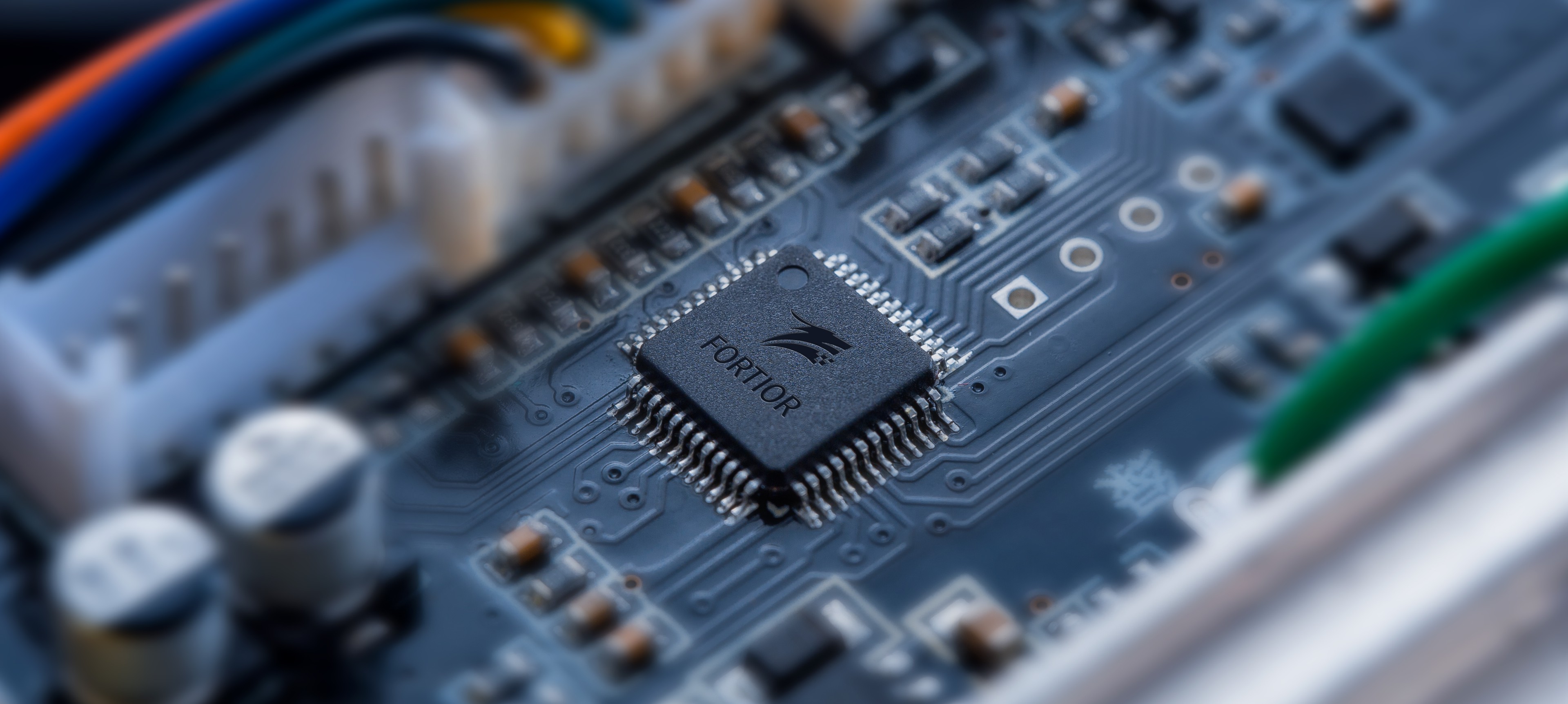
1. Dual-Core Heterogeneous Architecture: Precision Control Meets System Expandability
FU7562 and FU7512 share a unified architecture combining a dedicated ME2 motor control engine and a 32-bit RISC-V core. This division of labor ensures high-precision, real-time motor control while leaving ample headroom for flexible system-level expansions.
While built on the same technology platform, the two chips feature differentiated peripherals, PFC topologies, and driver resources to precisely target their respective markets.
1) ME2 Dedicated Motor Control Engine
Hardwired exclusively for motor control, the ME2 core accelerates a full suite of core algorithms—including FOC, DQ decoupling, torque compensation, deep flux weakening, and high-frequency injection. It incorporates seven motor observation algorithms and supports stable 10 Hz low-speed, heavy-load startup, completely eliminating compressor jitter and weak starting torque. Capable of up to 115 kHz carrier frequency for single-motor and 35 kHz for dual-motor synchronous control, it natively supports SiC and GaN devices with zero CPU intervention, ensuring ultra-fast and stable control loops.
2) 32-bit RISC-V General-Purpose Core
Independently handles non-real-time tasks such as system scheduling, parameter configuration, communication, fault protection, and host interfacing. Equipped with 64 KB Flash and 12 KB SRAM, it provides ample resources for feature iterations and peripheral expansion.
Architectural Differentiation:
1) FU7562 (Dedicated to Residential AC)
Integrates a 6N pre-driver, 5x AMPs, 6x CMPs, and 2x ADC groups. It adopts a single-leg hardware PFC topology, targeting 1HP–3HP residential wall-mounted and floor-standing units. By stripping redundant hardware, it minimizes peripheral BOM costs, perfectly aligning with the ultra-cost-effective mass-production demands of residential ACs.
2) FU7512 (Dedicated to Commercial AC)
Equipped with 7x AMPs, 8x CMPs, and 3x independent ADC groups, enabling isolated sampling for motor and PFC signals to eliminate cross-interference. It supports single-/dual-leg interleaved PFC and features 6 independent half-bridge PWM outputs. Designed specifically for 5HP+ commercial central ACs and VRF (Variable Refrigerant Flow) multi-split systems, it ensures long-term stability under heavy loads and harsh grid conditions.
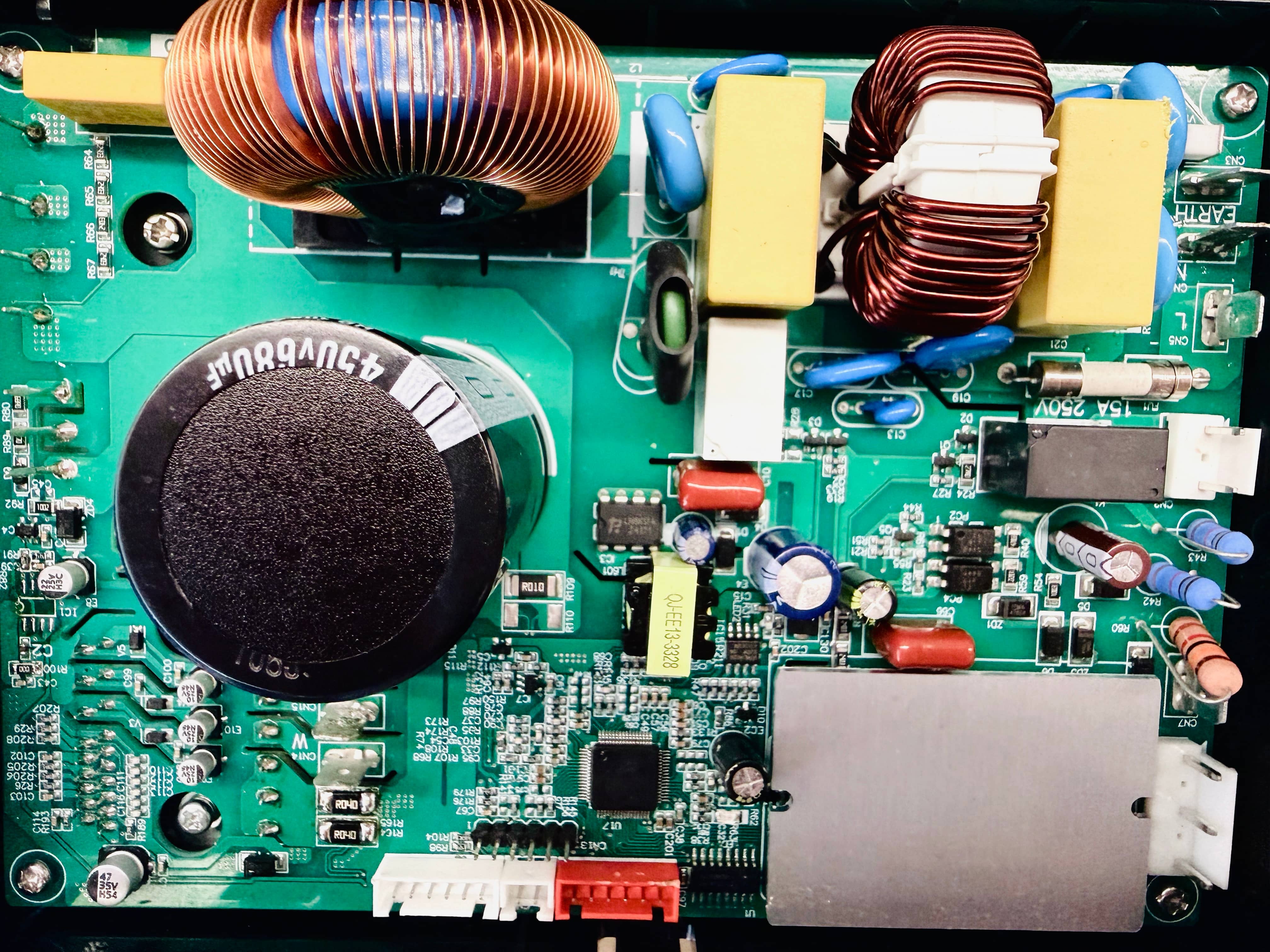
FU7512 Residential AC demo
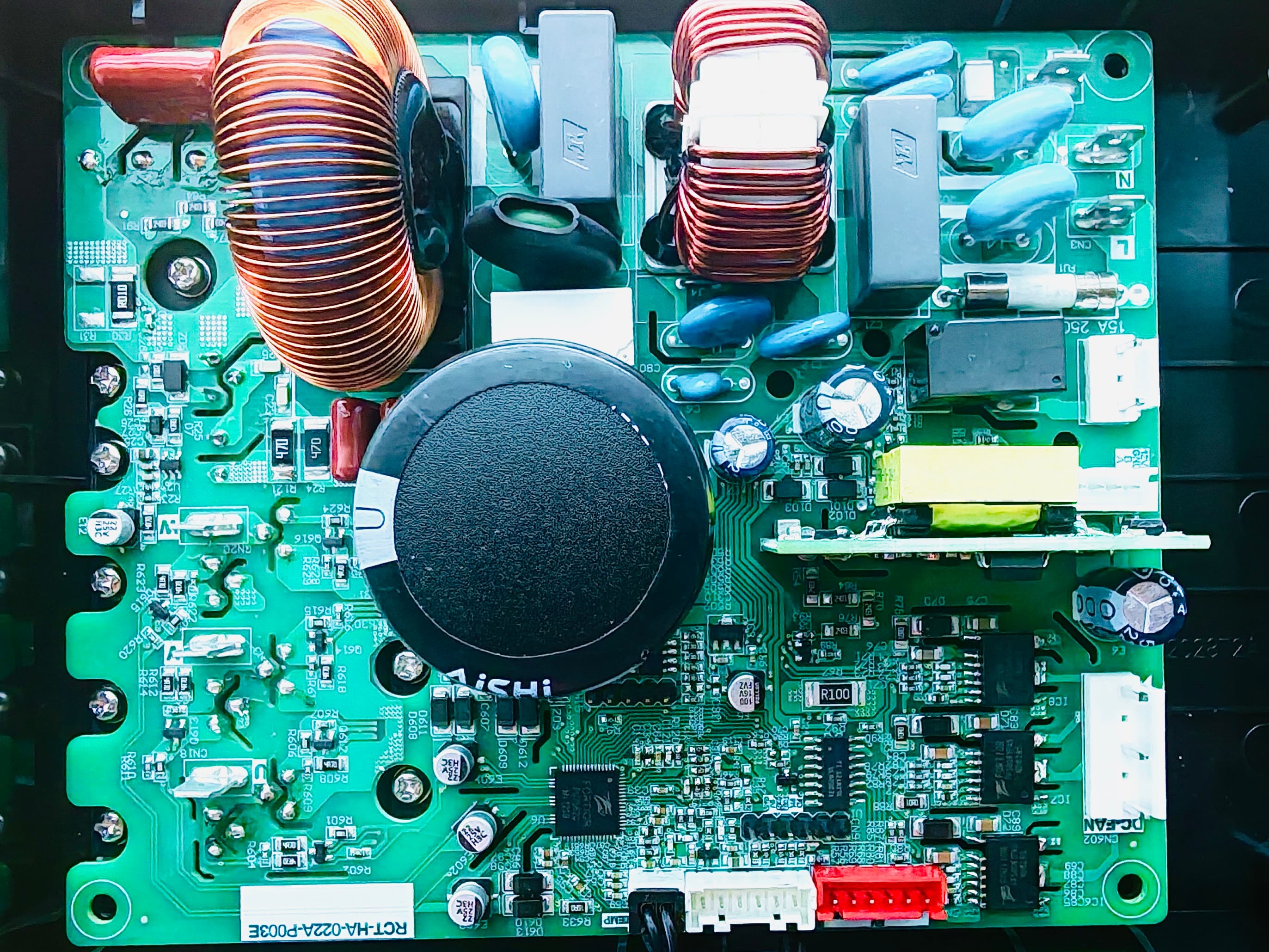 FU7652 Residential AC demo
2. High-Integration Hardware: Simplified BOM for Mass-Production Cost Reduction
Both chips highly integrate analog, digital, and driver peripherals, eliminating the need for numerous external op-amps, comparators, and gate driver ICs. This drastically simplifies PCB layout, reduces component count, and cuts mass-production costs at the source.
1) FU7562 – Ultra-Compact Residential Solution
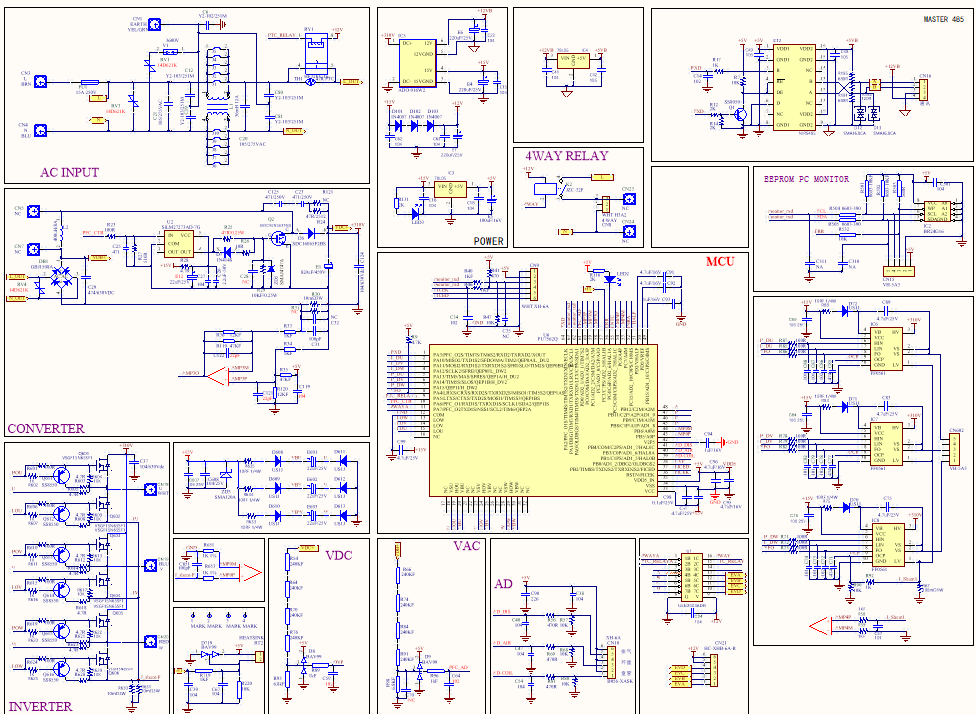
With its integrated pre-driver, the compressor stage requires only 6 power components. Compared to traditional multi-chip solutions, it achieves a 30% reduction in BOM cost, a 40% drop in component count, and a 35% shrink in PCB area. It even supports single-layer PCB designs, maximizing hardware cost compression without sacrificing performance and energy efficiency—ideal for residential AC mass production.
2) FU7512 – High-Power Commercial Integration
Adopts a multi-channel, independent, high-precision sampling architecture for superior anti-interference. It integrates CAN FD, BISS, and LIN high-speed communication interfaces to meet the networking and inter-unit connectivity demands of commercial VRF multi-split systems, fully adapting to complex commercial grids and sustained full-load operations.
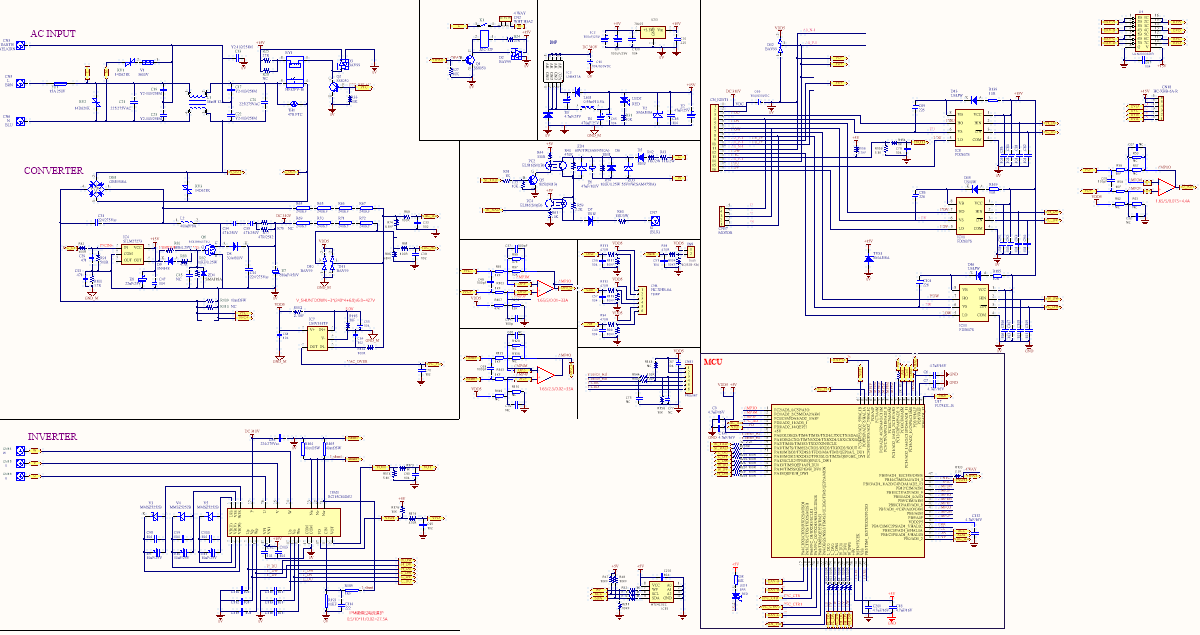
IPM Integration Solution
Separation Solution Architecture
Both chips feature a rich set of bus communication interfaces that support device debugging, signal interconnection between indoor and outdoor units, and multi-peripheral function expansion – seamlessly fitting into a systematic electronic control development framework for air conditioning systems.
3. Hardware PFC Technology: Maximizing Energy Efficiency and Power Density
Both chips feature a fully autonomous hardware PFC control unit. Sampling, compensation, current limiting, and PWM output are executed entirely in hardware without CPU intervention. They support adaptive CCM/DCM mode switching and include built-in hardware cycle-by-cycle current limiting and overload protection, ensuring efficient and stable system operation. Differentiated topologies address the distinct energy efficiency standards of residential and commercial applications.
1) FU7562 – Single-Leg PFC for Residential Use
Supports an 80 kHz high-frequency carrier, achieving a 0.98 power factor with standard IGBTs. The high-frequency design allows the conventional 400 μH inductor to be reduced to just 100 μH, significantly shrinking component size and lowering passive component costs, thereby facilitating the miniaturization of residential control boards while meeting strict energy regulations.
2) FU7512 – Dual-Leg Interleaved PFC for Commercial Use
Supports 80 kHz+ operation and is deeply optimized for SiC wide-bandgap (WBG) devices, reducing device temperature rise by over 15% and pushing system efficiency beyond 98%. The dual-leg interleaved topology evenly distributes current, reducing per-leg component load losses and significantly boosting power density. The power factor remains rock-solid at 0.98–0.99, perfectly suited for sustained full-load commercial operations.
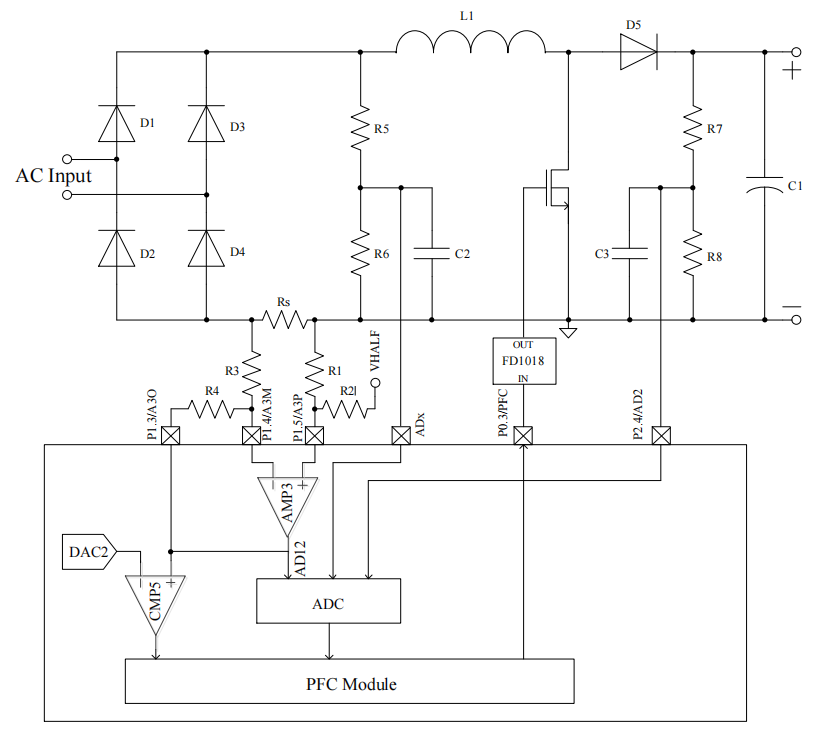
PFC Topology
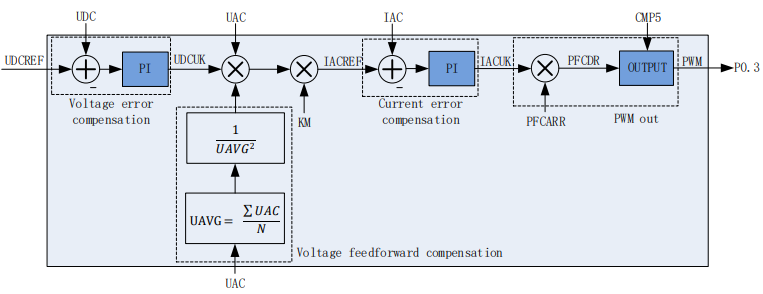
PFC Module
4. Hardwired DQ-Axis Algorithms: Solving Core Inverter Pain Points
Both chips share a full suite of hardwired DQ-axis control algorithms, delivering consistent, top-tier control performance. They specifically target industry pain points—difficult low-speed startups, severe load fluctuations, high-RPM limits, and tedious model-specific tuning.
1) High-Precision DQ Decoupling (Vibration & Noise Reduction)
Hardware-based orthogonal decoupling eliminates D/Q axis current cross-coupling, accelerating the current loop response. This effectively cancels out the periodic torque ripple of reciprocating compressors, suppressing system vibration, pipeline resonance, and operating noise—ensuring a quiet residential experience and extending compressor lifespan.
2) Q-Axis Torque Compensation (Heavy-Load Stability)
The chip monitors speed deviation in real time, dynamically injecting Q-axis compensation current to offset torque deficits from sudden load changes. This eliminates speed jitter, abnormal noise, and heavy-load stalling risks. The FU75 series features optimized compensation parameters for enhanced load-shock immunity.
3) D-Axis Deep Flux Weakening (Breaking the Speed Ceiling)
By precisely injecting negative D-axis excitation current to counteract rotor back-EMF at high speeds, the chip breaks through the bus voltage bottleneck, maintaining stable operation above 6,000 RPM for rapid cooling/heating. The FU75 series offers a wider flux-weakening range to fully unlock the ultimate performance of high-power models.
4) Adaptive Identification (Tuning-Free, Rapid Development)
The built-in, hardware-automated motor parameter identification achieves resistance and inductance estimation errors within 10%. Paired with an adaptive AO observer, it eliminates the need for manual back-EMF parameter entry—requiring only the pole-pair count for full adaptation, enabling fan tuning-free operation. FU7562 streamlines multi-model production line tuning for residential applications, while FU7512 enables rapid adaptation to commercial high-power motors – slashing overall development cycles by over 50%.
Additionally, both chips also support carrier frequency sweeping for EMC optimization and feature a single-shunt sensorless FOC algorithm that delivers low-speed acoustic performance rivaling dual-shunt solutions.
5. Wide-Bandgap (WBG) Readiness: Future-Proofing Energy Efficiency
Aligning with tightening global energy standards, both chips natively support SiC and GaN 3rd-generation semiconductors. They fully leverage the advantages (low loss, low temperature rise, and high frequency) of WBG devices, reserving ample headroom for future product iterations.
1) FU7562: Operates at a 70 kHz carrier to balance cost and efficiency, offering a highly cost-effective SiC adoption path for residential AC upgrades.
2) FU7512: Leverages high-frequency control and dual-leg PFC to maximize WBG performance, drastically reducing power consumption and thermal stress, enabling premium commercial ACs to achieve ultra-high energy efficiency ratings.
6. Full-Scenario Coverage: A Tiered Strategy for All AC Applications
With differentiated hardware and performance profiles, FU7562 and FU7512 precisely cover the full power spectrum of AC applications, while also extending to other inverter-driven equipment like fresh air systems.
Model | Target Applications | Power Range | Core Hardware & Advantages |
FU7562 | Residential inverter AC outdoor units (1HP–3HP, wall-mounted/floor-standing) | 80W–3000W | Integrated pre-driver, single-leg PFC, ultra-compact BOM, ultimate cost control for mass production |
FU7512 | Commercial central AC, 5HP+ high-power outdoor units | 100W–7000W (power unlimited for both single-phase and three-phase supplies) | Dual-leg interleaved PFC, 3x independent ADCs, rich communication interfaces, heavy-load stability, and superior anti-interference |
Beyond core air conditioning applications, both chips also support single-motor variable-frequency devices such as DC fans in fresh air systems – enabling rapid product line expansion across multiple categories with tuning‑free algorithms.
7. Two-Chip Tiered Portfolio: Wide AC Market Coverage
Built on a unified dual-core platform, FU7562 and FU7512 deliver a comprehensive inverter control solution through differentiated optimization:
1) Architectural Tiering: One ME2 + RISC-V foundation. FU7562 strips down peripherals for ultra-low-cost residential use, while FU7512 scales up sampling, PFC, and communication for heavy-load commercial demands.
2) Integration & Cost: Full integration of AMPs, CMPs, and drivers enables an ultra-compact BOM. FU7562 drives cost-efficiency for residential use, while FU7512 ensures high power density and reliability for commercial use.
3) Algorithm Unification: Hardwired core algorithms solve both residential acoustic and commercial heavy-load pain points out-of-the-box. The tuning-free feature drastically accelerates time-to-market.
4) Future-Proof Iteration: Full-series compatibility with third-generation semiconductors meets the strictest global energy efficiency regulations. Manufacturers can seamlessly switch between the two chips on the same platform without software re-architecture, minimizing R&D risks.
FU7562 and FU7512 are purpose-built dual-core MCUs tailored for the differentiated demands of the AC industry. FU7562 is the premier choice for residential inverter upgrades, offering ultra-high integration and unmatched BOM cost-efficiency. FU7512 is the robust backbone for commercial high-power systems, delivering exceptional reliability, efficiency, and anti-interference.
Sharing a core architecture and algorithmic advantages, these two chips provide global AC manufacturers with a tiered, all-in-one, and scalable dual-motor inverter control solution—comprehensively addressing the high-efficiency and miniaturization imperatives of the modern market.
To request datasheets, evaluation boards, reference designs, or customized technical support, please contact your local Fortior Technology technical service team.