


In conventional motor development, engineers often spend over 60% of their time on repetitive tasks such as software operation and model debugging, leaving little room to focus on core electromagnetic design. Traditional simulation software is often hindered by steep learning curves, cumbersome modeling workflows, and complex debugging processes. These challenges not only prolong development cycles but also divert focus away from the design itself, as excessive effort is consumed by tool operation rather than core electromagnetic field analysis.
To address these industry pain points, Fortior Technology (A-share: 688279.SH; H-share: 01304.HK) has independently developed MotorSim, a minute-level, high-accuracy motor electromagnetic simulation tool.
The newly released V1.0.4 version delivers a systematic upgrade across six core dimensions: UI interaction, modeling capability, algorithm accuracy, solver efficiency, material management, and winding visualization.
Adhering to the philosophy of “tools that adapt to people, not people to tools,” MotorSim promises a platform that is simple, fast to learn, and powerful in both efficiency and accuracy. Users can get started within five minutes to begin designing their first motor. By eliminating complex operations and streamlining workflows, the new version empowers engineers to complete electromagnetic simulations and in-depth analyses rapidly, allowing them to focus entirely on electromagnetic design while improving iteration efficiency and outcome quality.
UI Interaction: Lower Operating Costs
The new version reorganizes the interface layout with clearer functional zones, enabling smoother parameter configuration and result review.
A dedicated output window centrally displays run logs, computation progress, and exception prompts. Task status badges allow for quick identification of waiting, computing, completed, and error states, facilitating faster troubleshooting. Additionally, the flux density color map interaction has been optimized for more efficient result analysis.
For daily maintenance, the software introduces a unified entry for license management, online updates, and feedback submission. This one-stop approach reduces extra steps and eases the burden of software usage and maintenance.
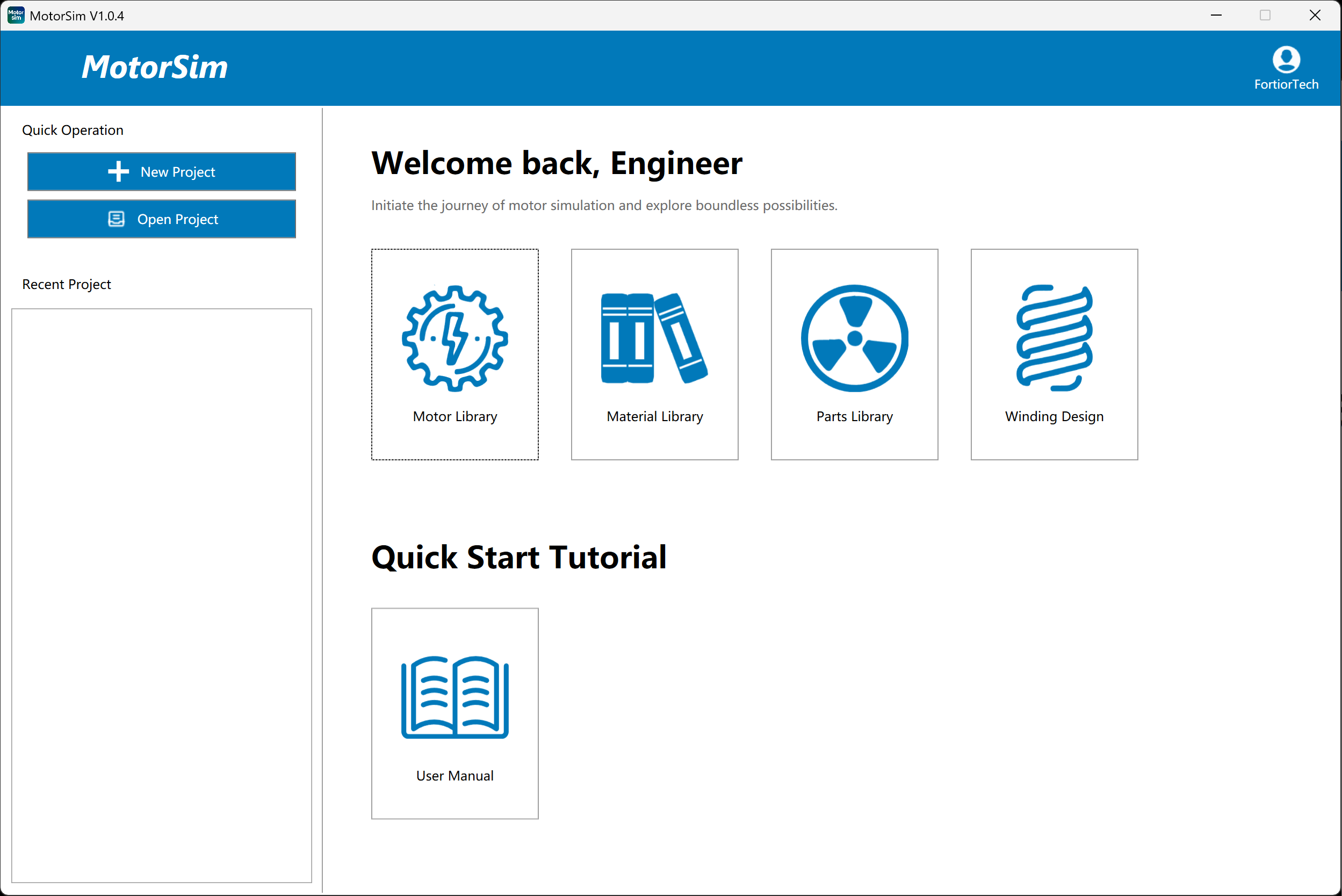 MotorSim Main Interface
Motor Library Upgrade: Adapting to Diverse Simulation Needs
This update enhances the motor library around real engineering needs, adding multiple practical simulation features:
Refined Loss Calculation: Bearing and windage loss simulations are now supported, moving beyond fixed empirical formulas. Parameters can be customized using measured project data, making results more consistent with actual operating conditions and enabling accurate efficiency evaluation.
Improved Winding Accuracy: Wire gauge and slot parameter calculations have been added, and the phase resistance algorithm is optimized to faithfully reproduce actual winding structures (e.g., parallel branches and conductors), yielding results with lower error.
Professional Analysis Functions: MAP solving, phasor diagram calculation, and harmonic distortion calculation are now integrated, enabling one-stop multi-dimensional performance analysis without exporting data across tools.
Flexible Magnetization: A dedicated polarization settings panel has been added. Parallel magnetization now supports free angle adjustment, and the sinusoidal magnetization mode is optimized to meet various permanent magnet modeling needs.
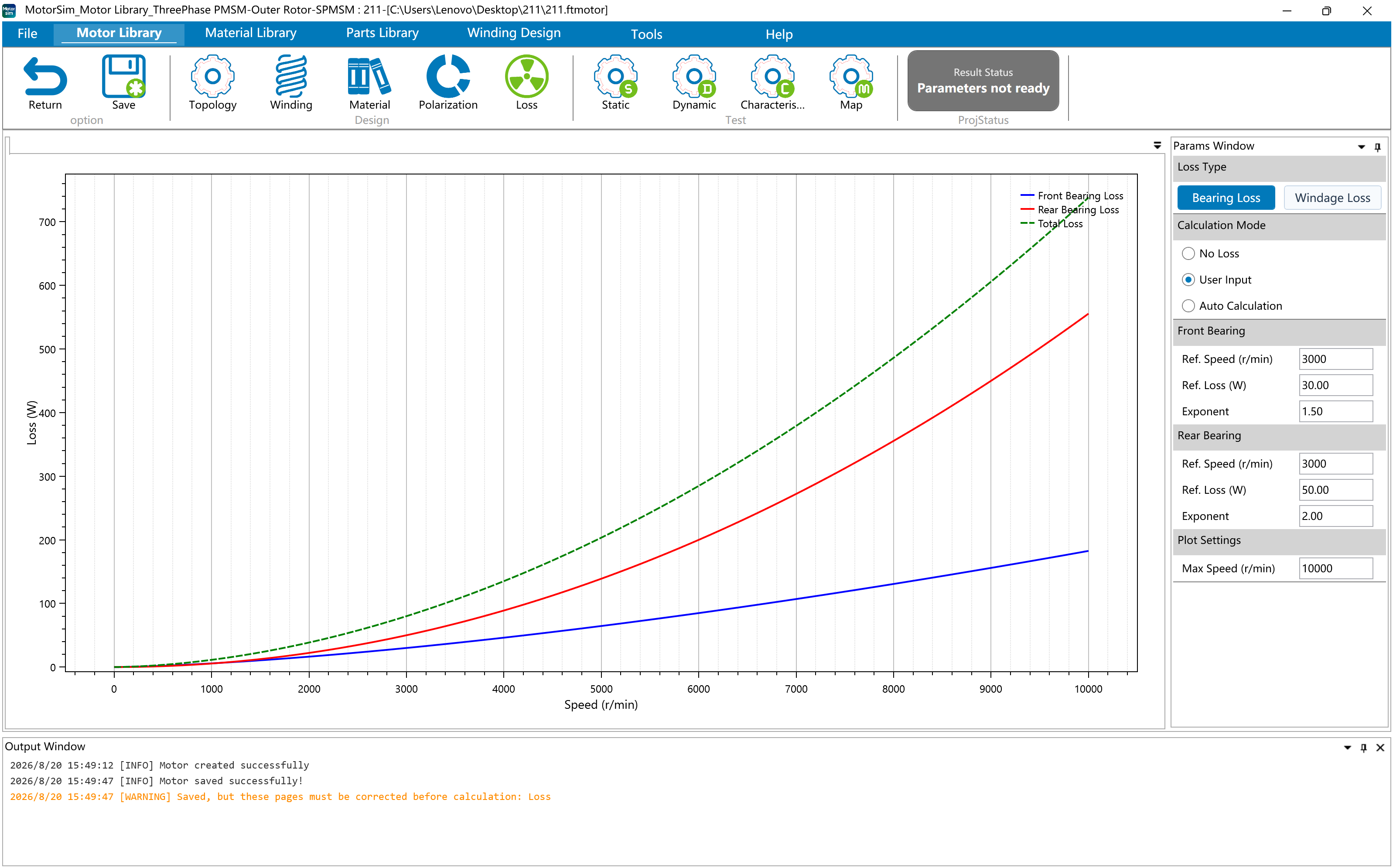 MotorSim Loss Setup
Streamlined Modeling: Less Manual Debugging
The new version significantly simplifies the entire modeling and modification process, shortening setup and iteration times.
Core simulation algorithms have been deeply optimized for real engineering scenarios, delivering automatic alignment of dynamic magnetic field current phase with rotor position angle, precise D-axis position angle calculation, efficient characteristic curve solving, reasonable current density limiting, and accurate phase resistance calculation.
This eliminates tedious manual debugging, aligns simulation logic with real industrial conditions, and helps engineers obtain more accurate and reliable data.
Solver Performance Upgrade: Shorter Simulation Time
The solver has been further optimized to improve electromagnetic simulation efficiency.
The software now features intelligent parallel solving that automatically matches the number of parallel threads to the user's hardware configuration, maximizing computing performance.
Large models, multi-condition simulations, and batch calculations (such as MAP and characteristic curves) benefit from significantly shorter simulation times, accelerating design verification.
Independent User Material Library: Reusable Across Projects
The material library has been substantially upgraded.
The new version adds gas and coil former material types and expands property parameters for permanent magnets, silicon steel, and conductors. Permanent magnets now support multi-temperature characteristic curves, and gas materials support five types of curves. For special structures, the rotor core can directly use “gas air” in computation.
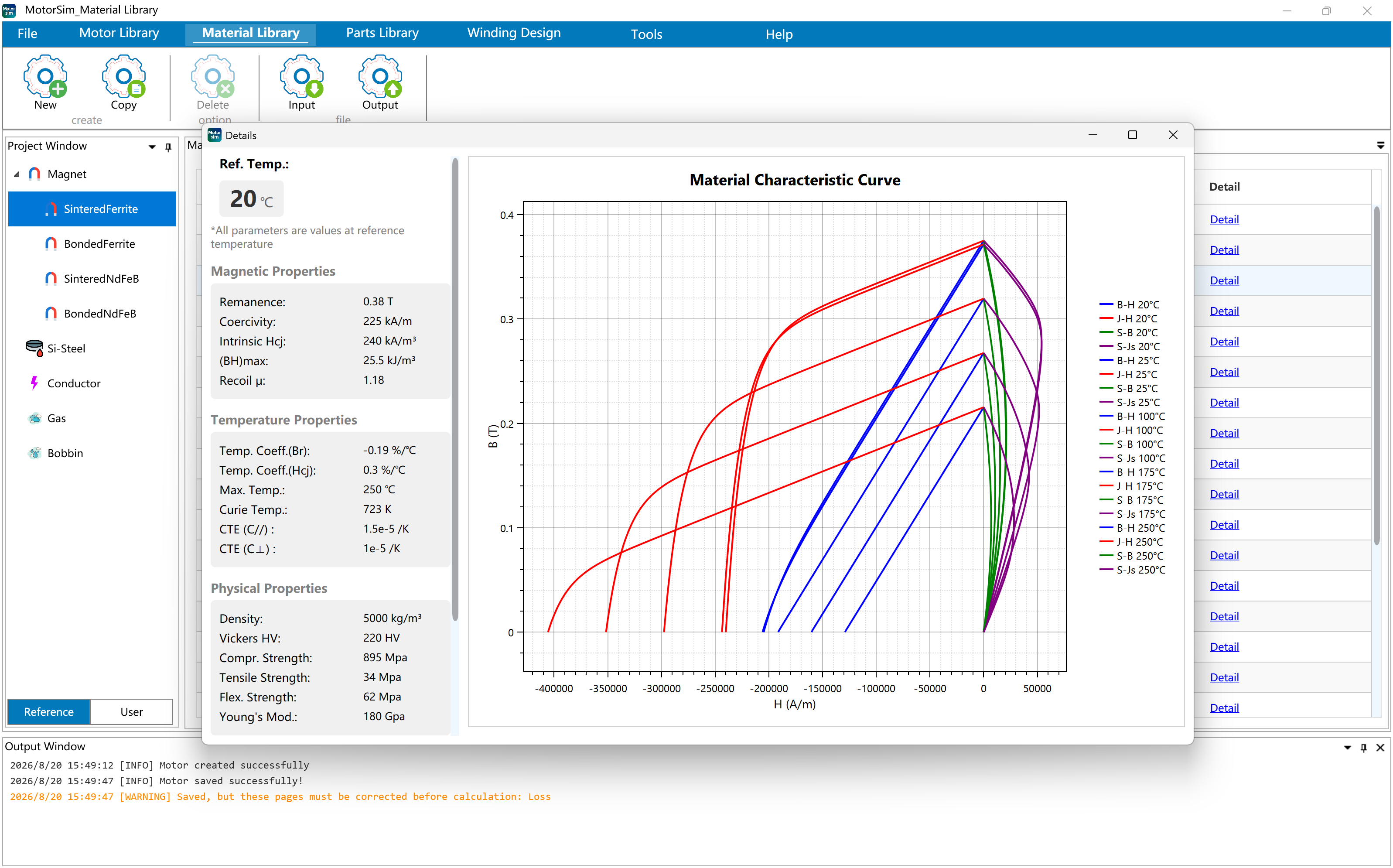 MotorSim Material Library
The highlight of this update is the independent user material library, which allows users to:
Create, duplicate, and delete material entries
Import/export complete material data and characteristic curves
Modify and save custom material properties
Perform curve fitting on material curves
Engineers can maintain measured material data for long-term reuse, no longer limited to the software's built-in library.
Enhanced Winding Visualization: Faster Design Verification
This version comprehensively optimizes the core winding library algorithms and visualization. It upgrades the winding connection calculation logic and end-winding structure display, and adds magnetomotive force (MMF) per-phase display.
Users can directly inspect the winding connection logic, overall end-winding structure, and per-phase MMF distribution, quickly identifying design issues without complex data analysis. This enables efficient verification and iterative optimization, greatly reducing the difficulty of winding debugging.
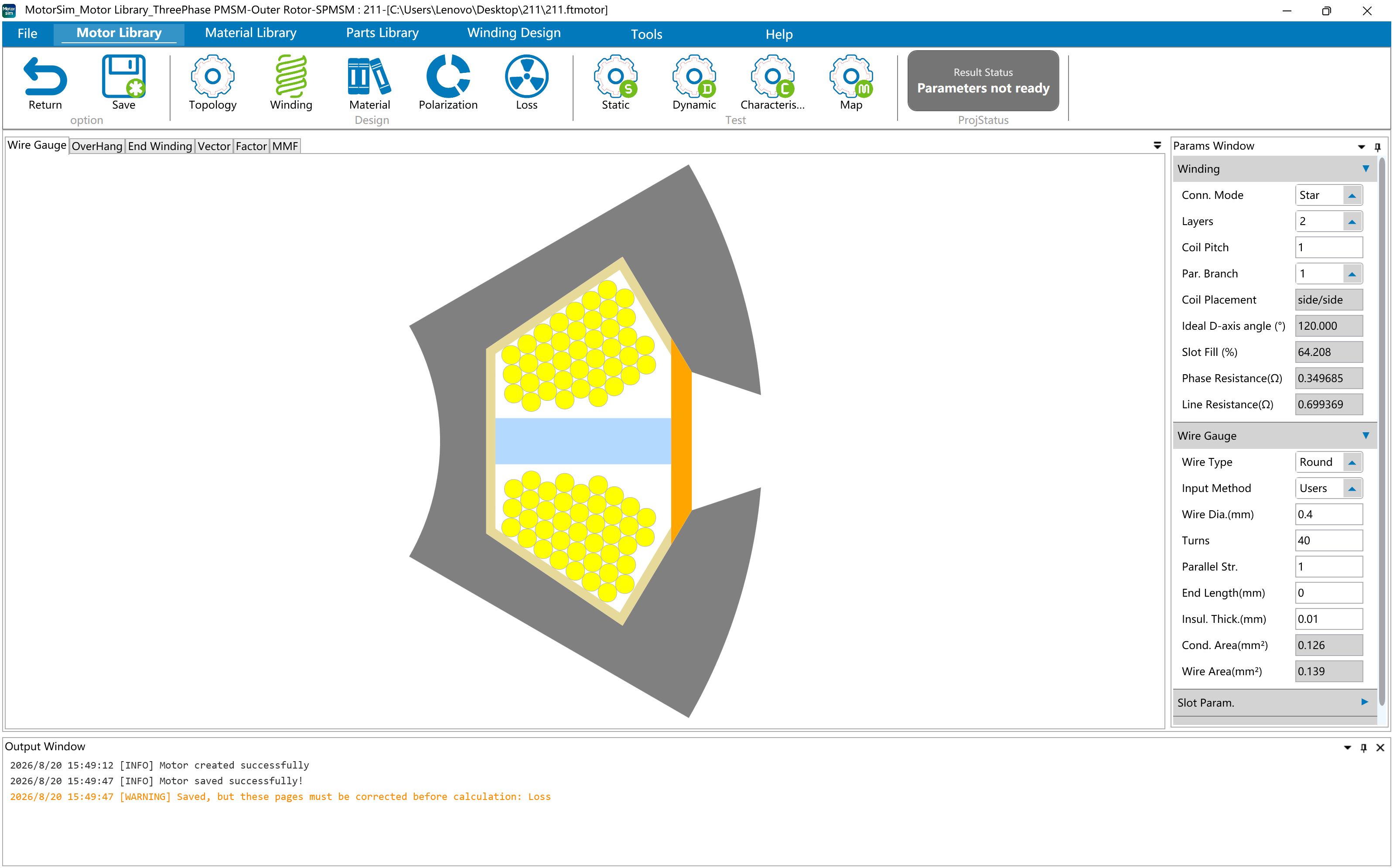 Winding Design Interface
Real-World Application Scenarios
Scenario 1: Motor Production Line
Traditional Approach: When a customer requests a new output power, front-line engineers must adjust key parameters (core stack length, winding turns, wire diameter) based on personal experience through repeated prototyping. This involves high trial-and-error costs and long delivery cycles.
With MotorSim: Simulation produces reasonable motor parameters within minutes. A single prototype build can essentially meet customer specifications, significantly shortening the trial-and-error cycle and improving delivery efficiency.
Scenario 2: New Project Development
Traditional Approach: New projects involve multiple analysis tasks (efficiency optimization, torque ripple suppression, BEMF harmonic improvement, demagnetization risk assessment), often requiring multiple tools and taking several days.
With MotorSim: Built-in full motor analysis capabilities generate complete analysis reports with simple operations, compressing days of analysis into minutes and accelerating new project delivery.
Built for real engineering scenarios, MotorSim V1.0.4 delivers a systematic upgrade across four key dimensions: operating experience, calculation accuracy, simulation speed, and scenario adaptability. It helps engineers greatly simplify simulation workflows, reduce inefficient repetitive work, and improve result reliability — achieving faster modeling, more accurate computation, and more efficient iteration.
Going forward, MotorSim will continue to iterate around real engineering needs, refine its core simulation capabilities, and provide professional, reliable tool support for efficient R&D and technological innovation in the motor industry.
MotorSim download: https://www.fortiortech.com/en/download/MotorSim